← Go Back


You've probably heard the saying "lift with your legs, not your back." Honestly, it's good advice. The problem is that almost no one explains how to actually do it. The missing piece is a movement called the hip hinge.
What Is a Hip Hinge?
A hip hinge is exactly what it sounds like: you bend at your hips, not your lower back. Your hips push backward, your chest lowers, and your spine stays in a strong, neutral position the whole time.
Think about someone deadlifting a heavy barbell off the ground. If they're doing it correctly, their back stays flat and their hips do the work. They don't round their spine to lift the weight. That's a hip hinge, and the same pattern applies whether you're lifting hundreds of pounds or a box off the floor.
The key difference is where the movement happens. In a proper hinge, your hips do the folding while your back stays flat and stable. When people "throw out their back," it's often because they did the opposite: they bent and lifted by rounding through the spine.
Why It Protects Your Back
When you hinge at the hips, the load is handled by the big, powerful muscles of your hips, glutes, and hamstrings. Your spine stays neutral and braced, which keeps stress off the more vulnerable structures of your lower back.
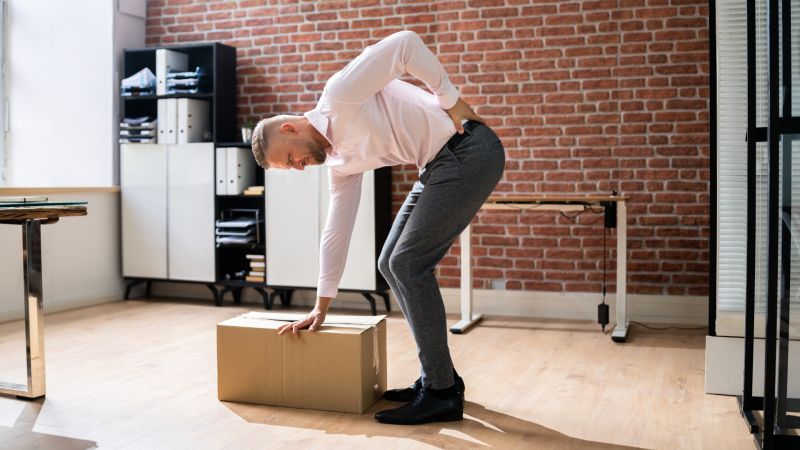
When you round your back instead, that load shifts onto your spine and its surrounding tissues, especially near the bottom of your lower back. Do that once with something heavy, or a thousand times with light everyday objects, and it's easy to see how problems build up.
Interestingly, most back tweaks don't come from lifting something heavy. They come from lifting something light in a careless way: a bag of groceries, a suitcase, a laundry basket, a toddler, a box off the floor. The hinge is what protects you in those everyday moments.
How to Do It
Here's a simple way to check your form. Hold a broomstick vertically against your back so it touches three points: the back of your head, your upper back, and your tailbone. As you bend forward at the hips, all three points should stay in contact with the stick. If your lower back starts to round, the stick will lift away from you. That's your signal that you're bending through your spine instead of hinging at your hips.
The important thing to understand is that the hip hinge isn't just a gym technique for lifting heavy. It's a movement pattern for everyday life, and as you get older, protecting your back this way can save you from a lot of unnecessary pain!
Want to Learn More? Check Out:
The assistant is still loading. Try again in a moment, or email hello@wellpro.ai.