← Go Back


Deep in your brain sits a small structure that quietly runs two of the most important functions you have: it turns your experiences into lasting memories, and it serves as your internal GPS, tracking where you are and where you've been. That structure is the hippocampus, and few people realize how much depends on it, or how fragile it is. It's among the first areas affected in Alzheimer's disease, sensitive to chronic stress, and prone to shrinking with age. But it's also remarkably responsive and capable of adapting to how you live. Understanding what it does, and what protects it, is genuinely valuable for anyone who wants to keep their mind sharp well into their later years.
The hippocampus is a small, curved structure buried deep in the brain. It gets its name from the Greek word for seahorse, which it closely resembles. You actually have two of them, one on each side of the brain, tucked within the temporal lobes near your ears.
Despite being relatively small, it sits at the center of some of the brain's most important work. It's part of the limbic system, which is the set of structures involved in memory and emotion, and it acts as a kind of hub, connecting to many other regions. This central, well-connected position is part of what makes it so influential, and unfortunately, also part of what makes it vulnerable.
What's remarkable about the hippocampus is that it's one of the few regions of the adult brain where new neurons can continue to be born, a process that appears to play a role in learning and mood. In other words, it isn't a fixed piece of hardware. It's dynamic, changing in response to how you live and what you ask of it.
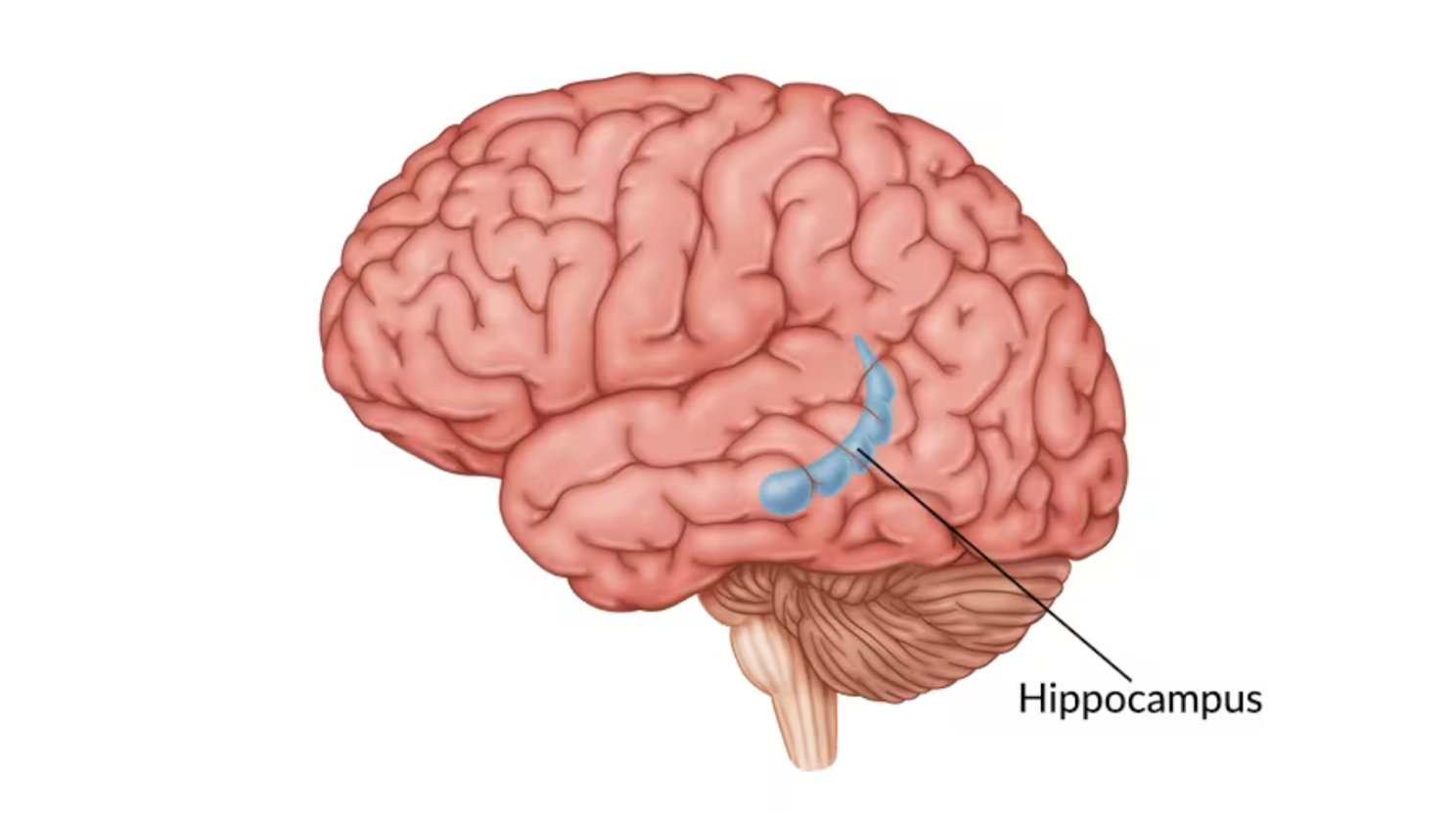
The hippocampus is best known as the brain's memory-making center, and for good reason. It plays an essential role in forming new long-term memories, particularly memories of facts and events, the kind of memories you can consciously recall.
Here's a simplified version of how it works. When you experience something, that information is initially held in short-term memory. The hippocampus acts as a kind of processing and transfer station, helping consolidate those experiences into stable, long-term memories that get stored across other regions of the brain. Without a functioning hippocampus, this transfer can't happen properly, which is why damage to it can leave someone unable to form new memories at all, even while older memories from before the damage remain intact.
A great deal of this consolidation happens during sleep. While you rest, the hippocampus appears to replay and strengthen the day's experiences, helping move them into long-term storage. This is one of the clearest reasons that sleep and memory are so tightly linked, and why a poor night's sleep can leave learning feeling like it didn't quite stick.
The hippocampus has a second major role that surprises most people: it's central to your sense of space and direction. It functions as a kind of internal GPS, helping you build and hold mental maps of your surroundings and track where you are within them.
Researchers have discovered specialized cells in the hippocampus that activate when you're in a specific location, effectively mapping the space around you. And in studies of people who navigate for a living, like taxi drivers who memorize thousands of streets, parts of the hippocampus have been found to be measurably larger, apparently shaped by all that spatial demand. It's a striking sign that this region physically responds to how much you use it.
Memory and navigation might seem like separate skills, but they're deeply linked in the hippocampus. Both involve organizing information into context, whether that's where you are in space or where an event sits in the story of your life. In a sense, the hippocampus helps you know both where you are and who you are.

For all its importance, the hippocampus is unusually fragile, and understanding why is key to protecting it.
Because it's metabolically active and highly connected, it's especially sensitive to certain kinds of stress and damage. Chronic stress is one of the clearest threats. Prolonged exposure to stress hormones like cortisol has been associated with harm to the hippocampus and can impair its function, which is part of why long periods of high stress can make memory feel foggy and unreliable.
The hippocampus is also one of the first regions affected in Alzheimer's disease, which is why memory loss is often one of the earliest symptoms. And it tends to lose volume gradually with age, which contributes to the more ordinary memory changes many people notice over time.
The point of laying this out isn't to worry you. It's to explain why this region deserves attention, and to set up the genuinely encouraging part: the hippocampus is also one of the most responsive regions in the brain, capable of strengthening in response to the right inputs.
Because the hippocampus remains changeable throughout life, the way you live has a real influence on its health. Several of the most effective strategies are well supported and, encouragingly, overlap with what supports overall health.
Exercise, especially aerobic exercise. This is one of the most powerful tools available. Regular aerobic exercise has been associated with increased hippocampal volume and improved memory, likely in part by supporting the birth of new neurons and boosting proteins that nourish brain cells. Movement may be one of the closest things we have to a direct investment in this region.

Prioritize quality sleep. Since the hippocampus does much of its memory consolidation during sleep, protecting your sleep directly supports its core function. Consistent, quality rest helps your brain lock in what you've learned.
Manage chronic stress. Because prolonged stress can genuinely harm the hippocampus, finding sustainable ways to lower it, whether through movement, relaxation practices, time in nature, or connection, is a direct form of protection for this region.
Keep learning and challenging your brain. Novelty and mental challenge engage the hippocampus and appear to support its health. Learning new skills, exploring unfamiliar places, and staying mentally engaged all give this region the kind of stimulation it responds to.
Stay socially connected. Social engagement is consistently associated with better cognitive health and may help buffer against age-related decline, including in memory-related regions.
Eat in a way that supports the brain. Dietary patterns rich in whole foods, healthy fats, and plenty of plants, and lower in ultra-processed foods, are associated with better brain health and may help protect the hippocampus over time.
The hippocampus is one of the clearest examples of how something small and easily overlooked can shape an enormous part of your life. It helps you form the memories that make up your story, gives you a sense of place in the world, and allows you to learn from what you have experienced. It also reflects the way you live. While it can be vulnerable to stress, poor sleep, inactivity, and neglect, it is also genuinely responsive to movement, rest, learning, connection, and the daily choices that support brain health.
That is the hopeful takeaway. Your memory is not simply something that fades with time. It is shaped by how you sleep, move, manage stress, stay curious, and engage with the world around you. Caring for your hippocampus is not just about protecting memory. It is about protecting the part of your brain that helps you learn, navigate, adapt, and hold on to the experiences that make you who you are.

The assistant is still loading. Try again in a moment, or email hello@wellpro.ai.