← Go Back


There's a strange pattern to learning almost anything. You struggle with something for weeks. A piece of music, a language, a golf swing, a new skill at work. It often feels clumsy and effortful every single time. Then one day, without any obvious change in how hard you're trying, it clicks. The thing that took all your concentration now happens smoothly, almost automatically. Most people chalk this up to practice, or muscle memory, or just getting used to it. What's actually happening is more interesting. Part of that shift comes down to a substance called myelin which is a fatty insulation that wraps around your nerve fibers and makes signals travel dramatically faster. When you practice something repeatedly, your brain appears to add insulation to the exact circuits you're using. Understanding myelin explains why skills feel impossible and then suddenly don't, why processing tends to slow with age, and what actually helps keep your brain fast.
Your brain and nervous system run on electrical signals. Those signals travel along nerve fibers called axons, which are the long, thin projections that carry information from one cell to the next. Without any coating, an axon conducts a signal relatively slowly. Wrapped in myelin, it conducts dramatically faster.
Myelin is a fatty, layered sheath produced by specialized support cells. In the brain and spinal cord, these are called oligodendrocytes, a type of helper cell that exists specifically to build and maintain myelin around nearby nerve fibers. Elsewhere in the body, in the nerves running to your arms, legs, and organs, a different cell called a Schwann cell performs that same wrapping job. Both work the same basic way, coiling around the axon in tight concentric layers, a bit like electrical tape wound around a wire.
The insulation isn't continuous. It comes in segments with small gaps between them, and the signal effectively jumps from gap to gap rather than traveling the entire length of the fiber. This jumping is what makes myelinated conduction so much quicker. In some fibers, myelination can increase signal speed many times over compared to an unmyelinated one.
If this sounds like a minor supporting role, consider the scale. More than half of your brain's volume is white matter, and it's called white matter precisely because of the pale, fatty appearance of all that myelin. We tend to talk about brain health almost entirely in terms of neurons, but a majority of your brain is essentially wiring and insulation.
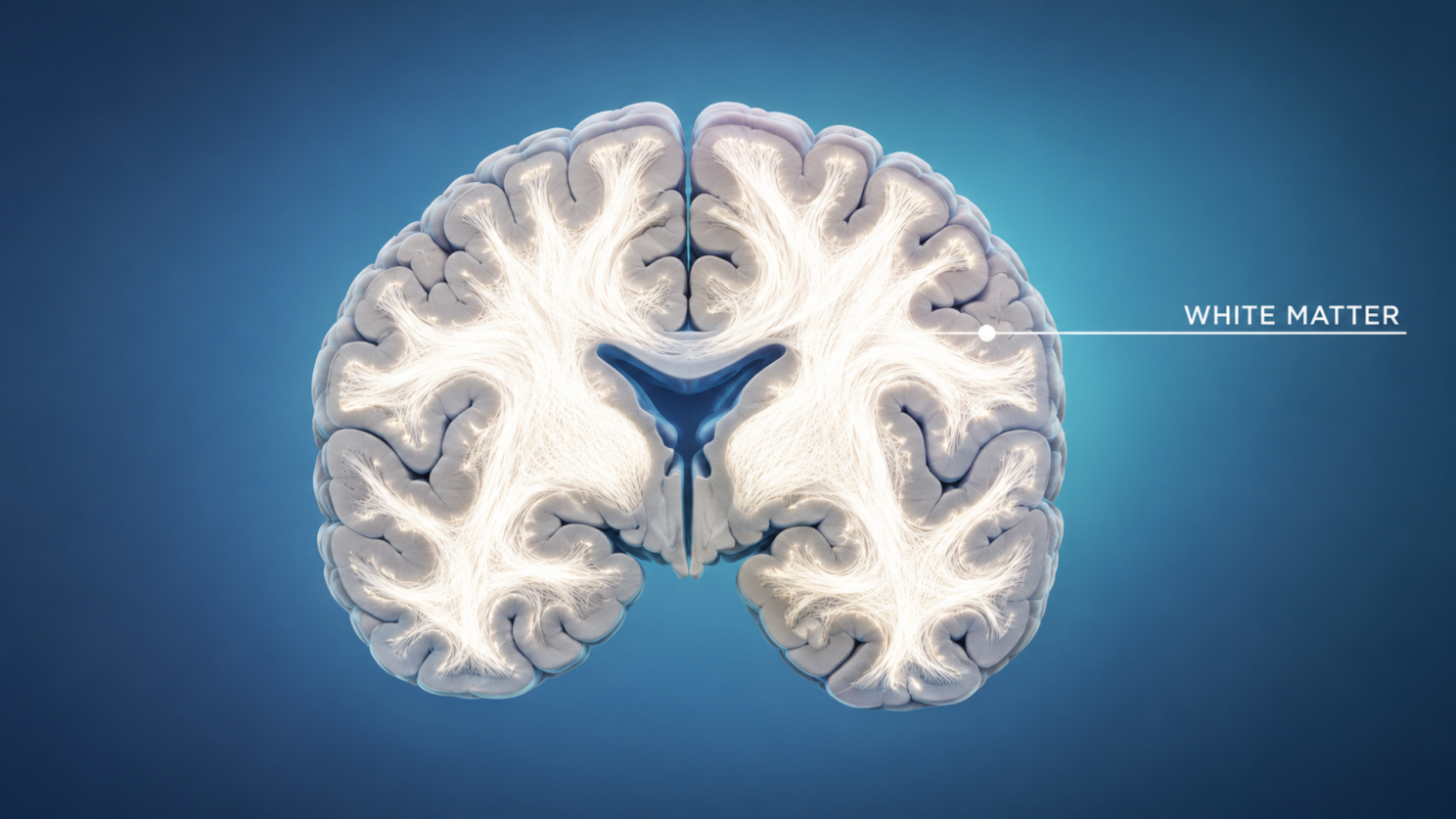
It's tempting to think of conduction speed as a technical detail. It isn't. Almost everything your brain does depends on different regions communicating with each other, and that communication has to arrive with the right timing.
Think of an orchestra. It isn't enough for each musician to play the right notes. They have to arrive together. When signals from different parts of the brain travel at different speeds, or arrive late, the coordination degrades. Researchers studying white matter have noted that even small delays in conduction can meaningfully disrupt the synchronized activity that complex thinking seems to depend on. In simple terms, when signals show up out of sync, your brain has to work harder to do the same job.
This is part of why myelin appears to matter for processing speed, working memory, reaction time, and the general sense of mental sharpness. It's less about how much you know and more about how quickly and cleanly the parts of your brain can talk to each other.
For a long time, the study of brain plasticity focused almost entirely on synapses, the connection points between neurons. The assumption was that myelin got laid down during development and then stayed largely fixed.
That view has shifted considerably. Research now suggests that myelination is responsive to activity throughout life. When a particular circuit fires repeatedly, the cells responsible for producing myelin appear to respond by adding or remodeling insulation along that pathway. Researchers sometimes call this activity-dependent myelination, and it's increasingly seen as a complementary form of plasticity alongside the synaptic changes we already knew about.
Human imaging studies support the general picture. Learning demanding skills like playing an instrument, acquiring a new language, or mastering complex balance tasks has been associated with measurable changes in white matter in the brain regions involved in that specific skill. Studies have also observed increases in myelin-sensitive imaging markers in the relevant regions after several weeks of focused training.
An honest note on the evidence: most of the direct, causal work has been done in animal models. Human studies rely on MRI measures that are sensitive to myelin rather than direct measurements of it, so the human picture is strongly suggestive rather than definitive. What's reasonably well established is that white matter changes with experience. Exactly how much of that change is myelin specifically is still being worked out.
White matter volume tends to peak around age thirty and gradually declines from there, and myelin appears to be a meaningful part of that story. The cells that produce and maintain myelin become less efficient at repair and replacement over the decades, and existing myelin can degrade. Research on brain aging suggests this loss of white matter integrity contributes meaningfully to the slowing of processing speed, partly by making communication between brain regions less efficient.
This tends to show up in subtle ways that have little to do with capability. A name might take a beat longer to surface, or a fast-moving conversation might require a bit more effort to track. Knowledge, judgment, and expertise often continue improving for decades, so what changes is usually speed rather than substance.
Notably, the regions that myelinate last during development, including areas at the front of the brain involved in planning and executive function, appear to be among the first to show age-related decline. It's a pattern researchers sometimes describe as last in, first out.
None of this means decline is inevitable in its pace or severity. Myelin remains responsive to activity across the lifespan, which is where the practical side comes in.
The honest framing here matters. There's no protocol that reliably thickens your myelin on demand, and anyone selling one is ahead of the evidence. What we do have is a set of habits that support the cells and processes involved, and that align with everything else known about brain health.

We talk about the brain as though it's all neurons, but a majority of it is the wiring and the insulation around that wiring. Myelin doesn't hold your memories or generate your thoughts. It determines how fast and how cleanly those thoughts move, which turns out to shape a great deal of how sharp you feel.
The most important thing to remember about myelin is what it implies about effort. That awkward, frustrating stretch when a new skill refuses to cooperate isn't wasted time. It appears to be the stimulus itself. The struggle is doing something structural, even when it doesn't feel like progress. So don't quit at the point where it feels hardest. That's usually right when the work is actually happening!


The assistant is still loading. Try again in a moment, or email hello@wellpro.ai.