← Go Back


Everyone has experienced it: the moment you know exactly what you should do and do the opposite anyway. You know you should go to sleep but you keep scrolling. You know the conversation needs a calm response but you snap. You know what you want to do but somehow the impulse wins.
That gap between knowing better and doing better is not always a willpower problem. It may actually be a brain problem, specifically a prefrontal cortex problem. Understanding how this region works can be incredibly useful when it comes to understanding your own biology.
The prefrontal cortex (PFC) is the large region of the brain located just behind your forehead, at the very front of the frontal lobe. It accounts for roughly 10 to 12 percent of the total volume of the human brain, and compared to other species, ours is disproportionately large. That size is not a coincidence. It is a significant part of what separates human cognition from virtually every other animal on the planet.
The PFC is not a single structure. It is made up of several interconnected regions, each contributing to different aspects of higher-order thinking. Broadly speaking, the prefrontal cortex is your brain's executive control center. It is responsible for planning, judgment, decision making, impulse control, emotional regulation, working memory, and the ability to weigh consequences before acting. When it is working well, you are thoughtful, measured, and intentional.
You can think of it somewhat like the CEO of a company. Different departments in the brain generate emotions, impulses, and motivations, but the prefrontal cortex evaluates those signals and decides what action should actually be taken. It helps coordinate everything so the system moves toward long-term goals rather than reacting to short-term pressures.
When it is compromised, even temporarily, those qualities are among the first things to go.
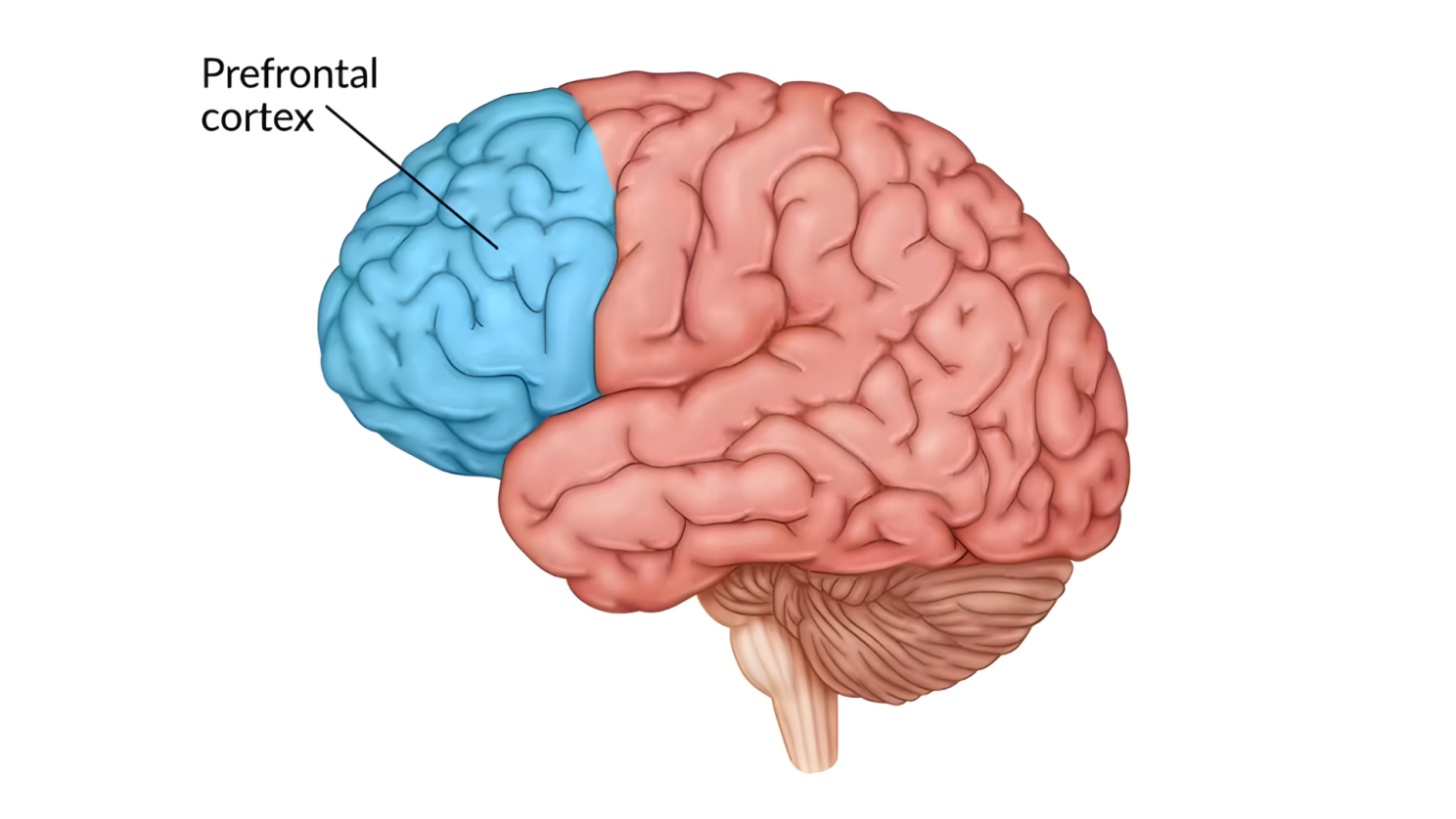
One of the most important facts about the prefrontal cortex is that it is the last region of the brain to fully develop. While other areas mature during childhood and early adolescence, the PFC does not reach full maturity until approximately the mid twenties. This is not a minor detail or something to overlook. It is one important neurological reason why adolescents and young adults are more prone to impulsive behavior, risk taking, and decisions that prioritize immediate reward over long-term consequences.
The PFC develops through a process called myelination, where nerve fibers are coated in a fatty substance called myelin that dramatically increases the speed and efficiency of neural communication. As myelination progresses through the twenties, so does the capacity for mature judgment, impulse control, and self regulation. It is one of the clearest examples in neuroscience of how brain structure directly shapes behavior.
Decision Making and Planning: The PFC integrates information from across the brain to evaluate options, anticipate consequences, and guide behavior toward longer term goals. It allows you to override an immediate impulse in favor of a better outcome down the road. Every time you choose the workout over the couch, or pause before responding to a difficult message, your prefrontal cortex is doing the heavy lifting.
Impulse Control: One of the PFC's most critical functions is inhibiting responses that are generated by more primitive brain regions, particularly the amygdala. The amygdala is your brain's threat detection and emotional reaction center. It responds extremely quickly, often before conscious thought has time to catch up. That speed can be useful in genuine danger, but it can also lead to reactions that are disproportionate to the situation. This is where the prefrontal cortex becomes essential. The prefrontal cortex acts as a braking system on those rapid, reactive responses. It allows you to pause, assess what is actually happening, and choose how to respond rather than simply reacting.
Emotional Regulation: The PFC plays a central role in how you manage and modulate your emotions. It does not suppress emotion, but it helps contextualize it. When you feel a surge of frustration or anxiety, the prefrontal cortex helps interpret that feeling, put it in perspective, and determine an appropriate response. When PFC function is impaired, emotional reactions tend to become stronger, less proportionate, and harder to recover from.

Working Memory: The PFC is essential to working memory, which is the brain's ability to hold and manipulate information in real time. It is what allows you to follow a complex conversation, keep track of multiple variables in a decision, or stay focused on a task without losing your train of thought. Working memory is closely tied to cognitive performance and is one of the first functions to suffer under conditions such as stress or sleep deprivation.
Social Cognition: The prefrontal cortex also plays a significant role in social behavior, including the ability to understand other people's perspectives, navigate complex social dynamics, and regulate how you present yourself in different contexts. Damage to or impairment of the PFC is consistently associated with difficulties in social judgment and interpersonal functioning.
This is where the science becomes especially practical. Because the PFC is one of the most metabolically demanding regions in the brain, it is also one of the most sensitive to the conditions you put your body and mind through on a daily basis.
Sleep Deprivation: Even one night of poor sleep can measurably reduce prefrontal cortex activity. Neuroimaging studies consistently show that sleep-deprived individuals display reduced PFC engagement during tasks requiring impulse control and decision making. At the same time, activity in the amygdala becomes more reactive. In simple terms, poor sleep tends to make people more impulsive, more emotionally reactive, and less capable of sound judgment.
Chronic Stress: Prolonged exposure to stress and elevated cortisol can impair the prefrontal cortex over time. Chronic stress causes dendritic retraction in PFC neurons, which means the physical connections between brain cells begin to shrink. At the same time, chronic stress strengthens activity in the amygdala. This shifts the balance of control away from rational, deliberate thinking and toward more reactive, survival driven responses.

Decision Fatigue: The PFC also fatigues with use. Research suggests that the quality of decisions tends to decline as the number of decisions made throughout the day increases. This phenomenon is commonly referred to as decision fatigue. This is one reason many high performers deliberately minimize low-stakes decisions such as clothing choices, meals, or routines. Doing so helps preserve cognitive resources for decisions that truly matter.
Alcohol: Even moderate alcohol consumption selectively impairs prefrontal cortex function. This is why alcohol often reduces inhibition, impairs judgment, and makes impulsive behavior feel more appealing. The PFC is particularly sensitive to alcohol's depressant effects on the central nervous system.
Poor Nutrition and Blood Sugar Instability: The brain relies heavily on glucose for energy, and the prefrontal cortex is particularly sensitive to fluctuations in blood sugar. Skipping meals, consuming foods that cause rapid spikes and crashes in blood sugar, or consistently under-fueling can all impair PFC function and contribute to poorer decision making throughout the day.
Traumatic Brain Injury and Repetitive Head Trauma: Damage to the prefrontal cortex can occur through traumatic brain injuries. Repeated head impacts, such as those seen in certain contact sports, have been associated with conditions like chronic traumatic encephalopathy (CTE). This condition can affect areas of the brain involved in impulse control, emotional regulation, and decision making, including regions of the prefrontal cortex. This helps explain why repeated head trauma is often associated with increased impulsivity, emotional instability, and difficulty regulating behavior.
The same lifestyle factors that support overall brain health tend to have an outsized effect on the prefrontal cortex.

That gap between knowing better and doing better often comes back to the prefrontal cortex. Many times it does not come down to a character flaw. It comes down to biology. And like any biological system, it responds to how you treat it.
When your PFC is well rested, well fueled, and protected from chronic stress, you show up as the version of yourself that makes decisions you are proud of. When it is depleted, even the best intentions tend to fall short.
The good news is that this system is highly responsive. The choices you make today, how you sleep, how you manage stress, how you move and eat, are either strengthening or weakening the very region of your brain responsible for making those choices in the first place.

The assistant is still loading. Try again in a moment, or email hello@wellpro.ai.