← Go Back


It's easy to fall into the trap of thinking that changing a habit comes down to willpower. The thinking goes that if you just wanted it badly enough, tried a little harder, or had more discipline, you'd finally stick with the gym or quit the late-night scrolling. And most of us have been there, watching a new resolution fall apart. But the science of habits tells a different and more freeing story. While willpower plays a role, especially early on, habits aren't mainly about willpower at all. They're automatic behaviors your brain builds through repetition, run by circuits designed to bypass conscious effort. That's why relying on willpower alone to change them so often fails: you're trying to fight a system that was specifically designed to run without your input. The good news is that once you understand how habits actually form in the brain, you can change them far more effectively, not by force, but by working with the way the system is built.
What a Habit Actually Is
A habit is simply a behavior that has become automatic through repetition. It's your brain's way of saving energy. Thinking through every decision from scratch is metabolically expensive, so when you do something the same way enough times, your brain hands that behavior off to run on autopilot, freeing up your conscious mind for other things.
This is why you can drive a familiar route and arrive with no memory of the trip, or find yourself halfway through a bag of chips you don't remember opening. Those behaviors have been automated. They no longer require your active attention, which is both the beauty and the danger of habits. The same machinery that lets you tie your shoes without thinking also runs the behaviors you wish you could stop.
By some estimates, a substantial share of daily behavior isn't conscious choice at all, but habit playing out in the background. That means the quality of your habits shapes an enormous amount of your life, often without you noticing.
The Habit Loop: Cue, Routine, Reward
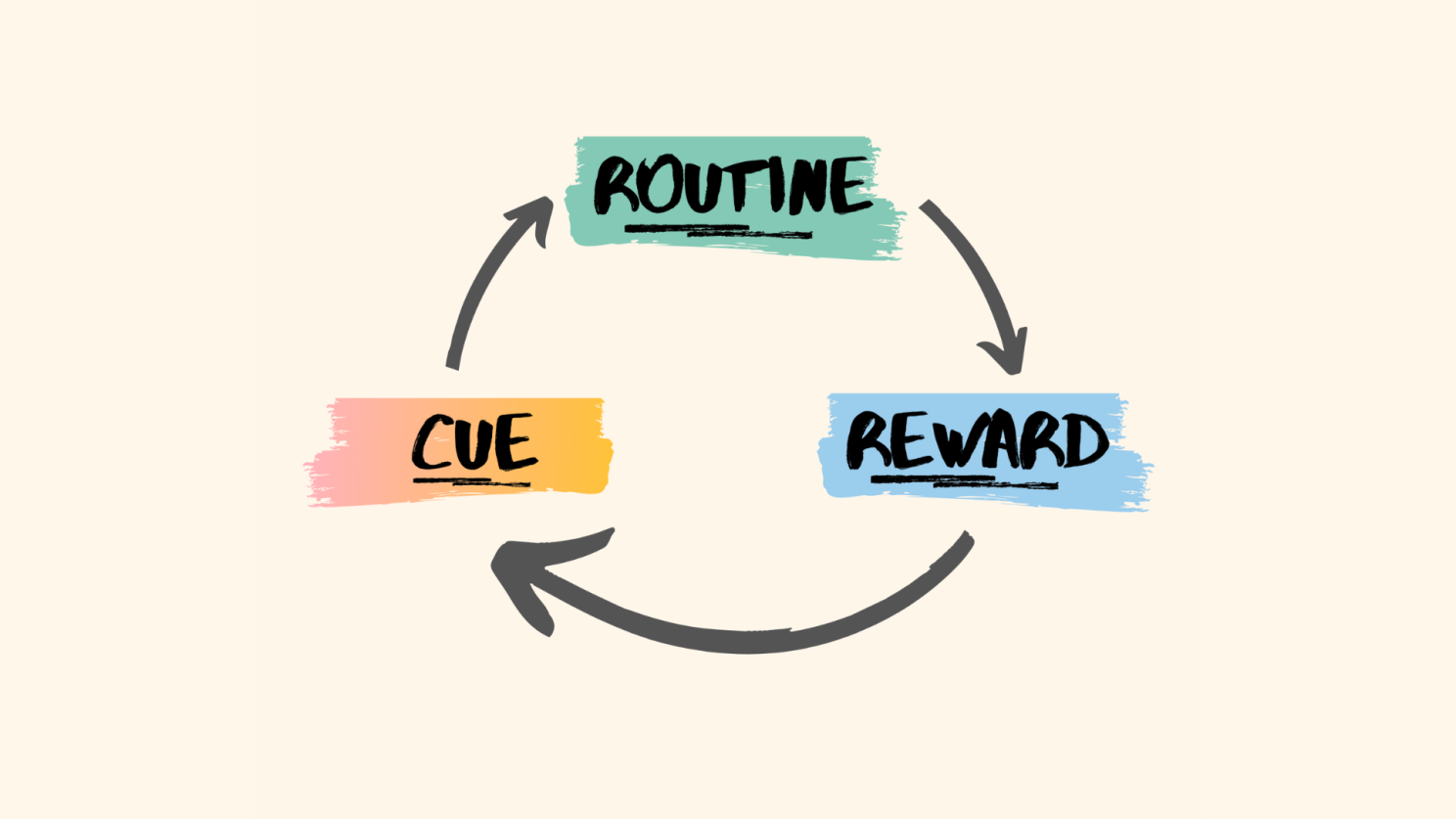
Researchers describe habits using a simple three-part cycle often called the habit loop.
First comes the cue, also called the trigger. It's the signal that tells your brain to start a behavior. It might be a time of day, a location, an emotional state, the people around you, or an action that precedes it.
Next is the routine, the behavior itself, whether that's reaching for a snack, checking your phone, or lacing up for a run.
Finally comes the reward, the payoff your brain gets from the behavior. The reward is what teaches your brain that this loop is worth remembering and repeating. Over time, with enough repetition, the cue alone becomes enough to trigger the whole sequence automatically, without any conscious decision in between.
Understanding this loop is powerful because it shows you where habits can actually be changed. The routine is only one part of a larger cycle, and often it's not the most useful place to intervene.
What's Happening in Your Brain
When a behavior is new, it's driven largely by the thoughtful, effortful parts of your brain, including the prefrontal cortex, the region behind conscious decision-making. This is why learning something new takes focus and feels tiring.
But as you repeat a behavior, control gradually shifts to a set of structures deep in the brain called the basal ganglia, and especially a region within it called the striatum. These areas are built for exactly this: taking a sequence of actions and compressing it into an efficient, automatic routine that can run with minimal conscious oversight. Neuroscientists sometimes describe this as the behavior becoming "chunked," bundled into a single automatic unit.
Once this shift happens, the habit is remarkably durable. The neural pathways formed through repetition don't simply disappear, which is part of why old habits can resurface even after long breaks. Someone who quit smoking years ago can still feel a pull when they encounter an old cue. The routine may be dormant, but the wiring remains. This is also why the most effective approach to changing habits isn't erasing them, but working with the loop and building new patterns alongside the old.
How Long It Really Takes
You've probably heard that it takes 21 days to form a habit. It's one of the most repeated claims in self-improvement, and it's essentially a myth, traceable to a misreading of an old observation that had nothing to do with habit formation in the way we mean it.
When researchers have actually studied how long it takes for a new behavior to become automatic, the picture looks quite different. Rather than a few weeks, it tends to take a couple of months on average, and the range is wide, with some people and simpler behaviors automating in just a few weeks while others take many months. Simpler habits generally tend to settle in faster than complex ones.
There's an encouraging finding in that research too: missing a single day doesn't appear to meaningfully derail the process. One slip doesn't erase your progress, which undercuts the all-or-nothing thinking that causes so many people to abandon a new habit after one bad day. The real lesson is that habit formation takes longer and is more forgiving than the popular timelines suggest. Consistency over time matters far more than perfection.
How to Build a New Habit
Because habits run on the cue-routine-reward loop, the most effective strategies work with that structure rather than relying on willpower. A few of the most useful:
Anchor the new habit to an existing cue. Rather than trying to remember to do something, attach it to a cue that already exists in your day. "After I pour my morning coffee, I'll take my vitamins" uses an established routine as the trigger. This is sometimes called habit stacking, and it works because you're borrowing a cue that already fires reliably.
Make it obvious and easy. The easier a behavior is to start, the more likely it becomes automatic. Lay out your gym clothes the night before. Keep the fruit visible and the chips out of sight. You're shaping your environment so the cue is present and the routine is low-friction.

Start absurdly small. A habit needs to be repeated to stick, and small habits are easier to repeat consistently. "Do two push-ups" is easier to automate than "work out for an hour," and once the habit is established, it naturally tends to grow.
Make the reward clear. Because the reward is what cements the loop, it helps to notice and even celebrate the payoff, whether that's the satisfaction of a check mark, how you feel afterward, or a small built-in treat. A behavior that feels rewarding is one your brain wants to repeat.
Be consistent, and be patient. Since automaticity can take a couple of months or more, the goal early on is simply repetition in a stable context. Aim for consistency, not perfection, and don't let a missed day convince you you've failed.
How to Break a Bad Habit
Breaking a habit is often harder than building one, because you're working against established wiring. But the same loop that builds habits offers the leverage to change them.
Target the cue, not just the routine. Since cues trigger habits automatically, one of the most effective strategies is to identify and reduce your exposure to them. If evening scrolling starts the moment you sit on the couch with your phone, the intervention is to change that setup, not to summon more willpower once the loop has already fired.
Replace, don't just remove. A habit fills a need and delivers a reward, so simply trying to stop often leaves a gap. It's usually easier to swap in a new routine that responds to the same cue and offers a similar reward, rather than trying to erase the behavior entirely.
Add friction. Just as making good habits easy helps them stick, making bad habits harder helps break them. Logging out of apps, keeping tempting foods out of the house, or putting an obstacle between you and the behavior all work by disrupting the automatic ease of the loop.
Change your environment. Because so many habits are tied to specific contexts, changing your surroundings can loosen a habit's grip. This is part of why habits are often easier to change during a move, a trip, or another disruption to your normal routine, when the usual cues are gone.
Working With Your Brain, Not Against It
The most freeing insight from the science of habits is that you are not simply weak-willed when a habit resists change. You're working against a system that was built, quite deliberately, to run without conscious effort. Willpower alone was never going to be enough, because willpower isn't where habits live.
What does work is understanding the loop and using it. Change your cues, shape your environment, start small, build in rewards, and give the process the weeks it genuinely takes. Do that, and you stop fighting your own brain and start directing it.
Your habits are not your destiny, but they are one of the most powerful forces shaping your days. Learning how they actually work turns them from something that happens to you into something you can consciously build!


The assistant is still loading. Try again in a moment, or email hello@wellpro.ai.