← Go Back


Everyone can relate: Some mornings you wake up sharp, energized, and ready before your alarm even goes off. Other mornings you drag yourself out of bed feeling like you barely slept, even though you got a full night of sleep. The difference often has less to do with how much sleep you got and more to do with whether your body's internal clock is running on schedule.
That internal clock is your circadian rhythm, and it's doing far more than managing your sleep. It's a 24-hour timing system that runs in virtually every cell in your body, coordinating when hormones are released, when your immune system is most active, when your brain is sharpest, when your metabolism processes food most efficiently, and when your body repairs itself. When this rhythm is aligned, you feel it. Energy is steady, focus is sharp, digestion works well, and sleep comes naturally. When it's disrupted (even by things that seem minor like inconsistent bedtimes, late meals, or too much screen time at night) the negative effects can quietly cascade across your entire body.
Your circadian rhythm is coordinated by a master clock in your brain called the suprachiasmatic nucleus: a tiny cluster of about 20,000 neurons located in the hypothalamus. This master clock takes its primary cue from light. When natural light enters your eyes in the morning, specialized photoreceptors (called intrinsically photosensitive retinal ganglion cells) send a signal directly to the suprachiasmatic nucleus, telling it that daytime has begun.
This signal sets the timing for the rest of your day. The master clock then communicates with peripheral clocks: the individual molecular clocks that exist in nearly every cell and organ throughout your body (trillions of them). These peripheral clocks regulate local processes like when your liver is most efficient at metabolizing nutrients, when your muscles are primed for peak performance, and when your immune cells are most active in scanning for threats.
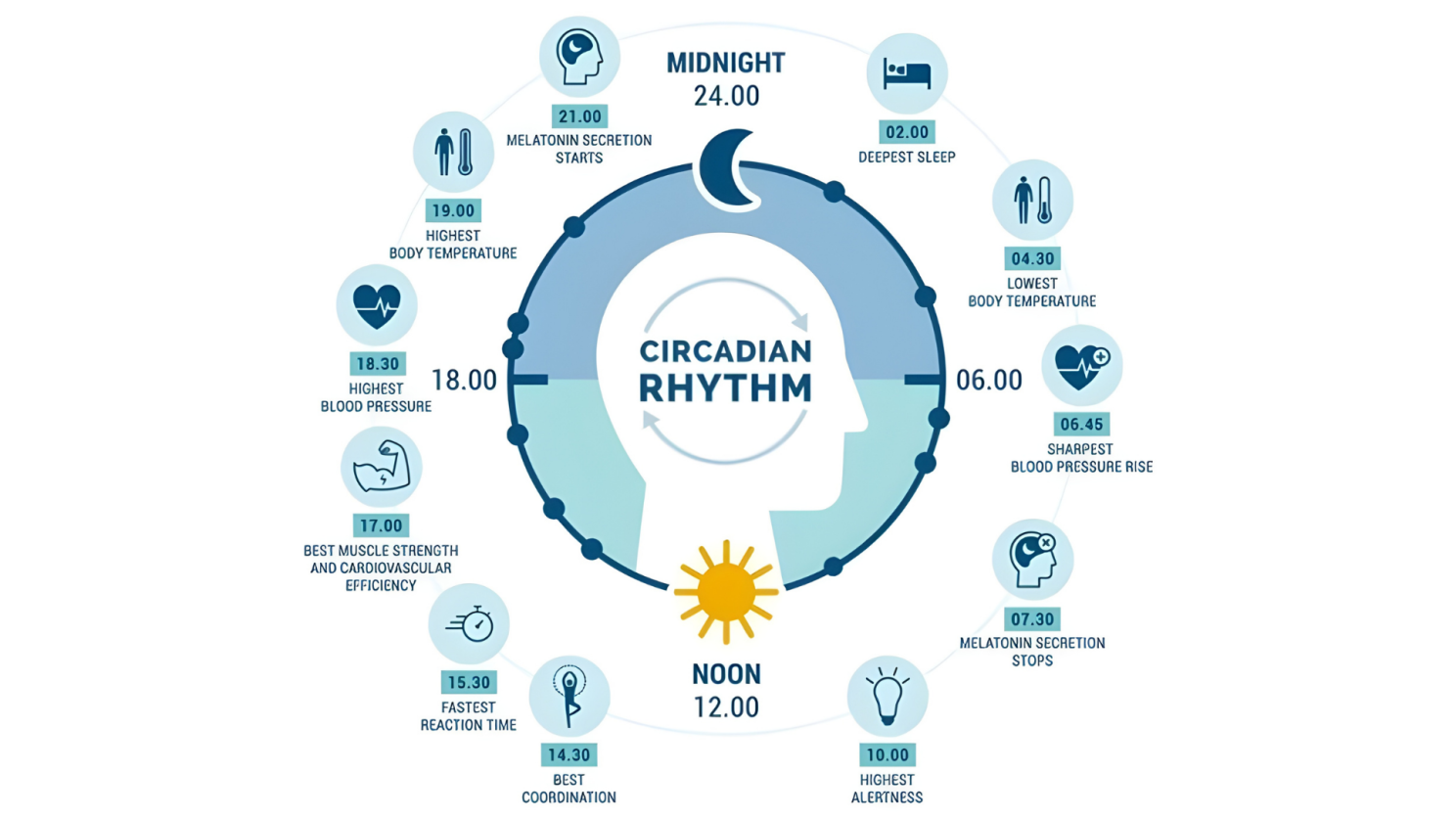
The system works on a roughly 24-hour loop. In a healthy rhythm, cortisol rises in the early morning to wake you up and give you energy. Body temperature gradually increases through the morning and peaks in the late afternoon, which can help support physical performance. Cognitive function tends to be sharpest in the late morning. Digestion is most efficient earlier in the day when metabolic enzymes and insulin sensitivity are at their highest. As evening approaches, cortisol declines, melatonin begins to rise, body temperature drops, and your body prepares for sleep and overnight repair.
When this entire sequence is running on schedule, every system in your body benefits from being active at the right time and resting at the right time. When the timing is off, systems that should be active are suppressed and systems that should be resting are activated, creating inefficiency and stress at the cellular level.
Metabolic Health: Your body processes food differently depending on when you eat. Insulin sensitivity tends to be highest in the morning and declines through the evening. Research has shown that the same meal eaten at noon versus midnight can produce a measurably different blood sugar response. Eating late at night, when your metabolic machinery is winding down, can contribute to elevated blood sugar, increased fat storage, and insulin resistance over time. This is one reason why meal timing has become such a focus in metabolic health research.
Immune Function: Your immune system follows its own circadian pattern. Immune cell production, inflammatory signaling, and pathogen surveillance all fluctuate throughout the day. Disrupting this rhythm can impair your body's ability to respond to infections and may contribute to chronic low grade inflammation: a state in which the immune system remains mildly but persistently activated, even in the absence of an acute threat. Over time, this type of smoldering inflammation has been linked to a range of conditions including cardiovascular disease, metabolic disorders, and accelerated aging. Research on shift workers has consistently found higher rates of inflammatory conditions and weakened immune responses, likely driven in part by chronic circadian misalignment.
Brain Function and Mood: Cognitive performance, memory consolidation, attention, and emotional regulation all follow circadian patterns. Your brain is typically sharpest in the late morning and early afternoon when cortisol and body temperature support alertness. Disrupted circadian rhythms have been associated with increased risk of depression, anxiety, and cognitive decline. Sleep quality, which is heavily dependent on circadian alignment, directly affects the brain's ability to clear metabolic waste, consolidate memories, and regulate mood.
Cardiovascular Health: Blood pressure, heart rate, and vascular function all follow circadian patterns. There's a reason heart attacks and strokes occur more frequently in the early morning hours, when the cardiovascular system is ramping up activity for the day. Chronic circadian disruption has been linked to increased cardiovascular risk, likely through mechanisms involving inflammation, blood pressure dysregulation, and metabolic stress.
Cellular Repair and Gene Expression: Perhaps most remarkably, research has found that a significant percentage of your genes follow circadian expression patterns. This means the timing of when certain genes are turned on and off throughout the day is regulated by your circadian clock. These include genes involved in DNA repair, cellular maintenance, and immune regulation. When circadian rhythm is disrupted, the timing of these critical repair processes can be thrown off, potentially accelerating cellular aging and increasing disease vulnerability.
Inconsistent Light Exposure: Light is the strongest signal your master clock receives. Insufficient morning light delays the clock, while excessive artificial light at night (particularly blue light from screens) suppresses melatonin production and signals daytime to your brain when it should be winding down. This combination of too little light in the morning and too much at night is one of the most common circadian disruptors in modern life.

Irregular Sleep Schedules: Going to bed and waking up at different times (especially varying by more than an hour between weekdays and weekends) creates what researchers call "social jet lag." Your internal clock gets conflicting signals about when day and night are, making it difficult to maintain a stable rhythm. Even if you're getting enough total hours of sleep, inconsistency can blunt the cortisol awakening response and impair overall sleep quality.
Late-Night Eating: Eating late at night sends an activity signal to your peripheral clocks (especially in the liver and digestive organs) at a time when they should be entering their rest phase. This can create a mismatch between your master clock (which knows it's nighttime) and your peripheral clocks (which think it's time to be active), disrupting metabolic function and sleep quality.
Shift Work and Jet Lag: Working against the natural light-dark cycle forces your body to be active when it's programmed to rest. Chronic shift work has been associated with increased rates of metabolic disease, cardiovascular problems, mood disorders, and certain cancers. Jet lag can also create a temporary version of this same mismatch, where your internal clock is out of sync with local time.
Chronic Stress: Sustained stress can elevate cortisol at inappropriate times, particularly in the evening when it should be declining. This interferes with melatonin production, delays the ability to fall asleep, and disrupts the natural cortisol curve that forms the foundation of your circadian rhythm.
Morning Light Exposure: Getting bright natural light within 30 to 60 minutes of waking is one of the most powerful things you can do for circadian health. Morning light reinforces the cortisol awakening response, sets the timing of melatonin production for that evening, and synchronizes your master clock with the external day. Even 10 to 15 minutes of outdoor light on a cloudy day provides significantly more lux than indoor lighting.

Consistent Sleep and Wake Times: Going to bed and waking up at the same time every day (yes, including weekends) gives your circadian system a stable anchor. This consistency supports the natural cortisol curve, optimizes melatonin timing, and improves overall sleep quality.
Earlier Meal Timing: Aligning your food intake with the earlier part of the day (when insulin sensitivity and metabolic efficiency are higher) can help support your peripheral clocks. Finishing your last meal at least two to three hours before bedtime allows your digestive system to enter its natural rest phase alongside the rest of your body.
Reducing Evening Light Exposure: Dimming lights in your home after sunset and limiting screen time in the hour or two before bed helps protect melatonin production. The type of light matters here too. Blue light (emitted heavily by LED screens and many modern bulbs) is the most stimulating wavelength for your master clock because it closely mimics the spectrum of midday sunlight. In the evening hours, transitioning to warmer light sources (those with lower color temperatures, in the range of 2700K or below) sends a much gentler signal to your brain. Options like incandescent-style bulbs, amber lamps, or even candlelight are well-suited for winding down. If screens are unavoidable, blue light filtering glasses or enabling the warm "night mode" setting on your devices can help reduce the signal that tells your brain it's still daytime.
Consistent Exercise Timing: Regular exercise helps reinforce circadian rhythms, particularly when performed at consistent times. Morning or early afternoon exercise aligns well with the natural cortisol and body temperature curves. Late-night intense exercise can elevate cortisol and body temperature at times when they should be declining.
Managing Stress: Since chronic stress directly disrupts the cortisol rhythm that anchors your circadian cycle, stress management practices like breathwork, meditation, time in nature, and social connection can indirectly support circadian health by helping to keep cortisol patterns on track.
If there is one takeaway, it's this: your circadian rhythm is not just a sleep clock. It's the master timing system coordinating your hormones, metabolism, immunity, brain function, cardiovascular health, and cellular repair... all working together across your entire biology
What's encouraging is that supporting it doesn't require anything complicated. Get morning sunlight, keep a consistent sleep schedule, eat earlier when possible, manage your evening light exposure, and move your body at regular times. These are just a few of the strategies you can leverage to optimize your energy, mood, sleep quality, and long-term health. Everyone is different, so finding the combination that works best for your lifestyle is part of the process too.
When your circadian rhythm is running on schedule, you will feel it in your energy levels, your focus throughout the day, your mood, and your overall sleep quality. Your body was designed to run on a rhythm. The closer you stay to it, the better everything works!


The assistant is still loading. Try again in a moment, or email hello@wellpro.ai.